Lucifer as Guru: A Mokșa-Centered Path

One year ago, I had started spending a lot of time with Lucifer in a way not dissimilar to how you gradually spend more time with a person in the lead up to entering a committed relationship. In this last year, I have been exposed to so many fellow Luciferians/Satanists and it's been kind of like an infinite course chef's meal (which is appropriate because man does Lucifer love food, especially the indulgent variety). It's really opened my eyes to the fact that sometimes you and other people can be devoted to the same deity, but not at all have the same values, ways of doing things, or types of relationships with him.
Some of the contacts I've had with other Luciferians were admittedly traumatizing. Others, including some of you who read this blog now, have been incredibly helpful connections to me. I didn't actively seek the path I am about to talk more about; much of it was answering broad intuitive calls and Lucifer bringing me to where I needed to go or who had the information I needed to push forward. However, if I look back on what I was searching for (what witchcraft might call "the intent") when I called Lucifer in December 2024 using Jason Miller's invocation in Consorting with Spirits, I can see quite clearly why my relationship with Lucifer is the way it is and how it has come to take this shape. I used an invocation that co-existed with a prayer that was based off the fourfold bodhisattva vows and when Lucifer arrived, I squealed out that I wanted liberation and justice for the masses, which... turns out, is the whole point of Mahayana Buddhism. Presumably, everything that has come afterward has spawned from my need to convert to a form of spirituality that can help me aim to achieve mokșa.
Basically: I'm a Luciferian Buddhist, although the way Lucifer has helped me frame my spiritual path goes deeper than that. It must be said that most westerners don't know that "Buddhism" is not necessarily a religion that is practiced the same way by any two Buddhists. Its core value involves worshipping the Buddha as a way to achieve Enlightenment, or at least attempt to be reincarnated into a better realm after death. Often this includes accepting the four noble truths and following the eightfold path among incorporating other Buddhist principles, though historically it has also looked like common forms of spirit propitiation.
In talking to several Buddhists who were born into the religion from various regions and reading John S Strong's Buddhisms: An Introduction, it's become more clear to me how Buddhism adapted to meet its adherents as it swept throughout Asia. It married anything that pre-existed in the regions, cultures, and contexts it landed, including the multitude and variety of local spirit pantheons. So even now, combining Buddhism and modern polytheism in a spiritual path is a continuation of Buddhism's journey throughout history. However, that also means there is a lot of religious detail that has to be personally decided by the solitary Buddhist. As someone whose entire life is spiritual work, I desired more structure, practices, and cosmology that built well into my previous spiritual experiences as well as my current learning, and Lucifer was well aware of it.
I've also alluded to the slight conflict in my cosmological experience that connects to the Shaivist and Shaktist umbrella of religious traditions. Shaivism/Shaktism holds that Shiva is the creator and Shakti the creative energy of the universe, both equal partners in the continuous formation of life as I witnessed in my gnosis experience. Meanwhile, Gautauma Buddha did not consider the creation of the world to be a relevant question and the original Pali canon suttas suggest that deities (or devis) are to find Enlightenment desirable and as worth pursuing as humans, sometimes equivocating them with us. In practice, Buddhist polytheism has neither one attitude nor position for the gods.
*
Ultimately, Lucifer helped me find a relatable touchpoint of these two religions in historical Kashmir. According to Strong's book, the Buddha's personal attendant Ānanda ordained and transmitted the Dharma to a renunciate named Madhyāntika. Ānanda then told Madhyāntika to go to Kashmir and spread the Buddha's teachings.
Buddhism and Shaivism flourished together particularly under the reign of Emperor Ashoka, which lasted between 268 and 232 BCE. That said, documents on historical Kashmir are scarce and what we have is largely in Sanskrit, yet to be translated into English. So what is there to find that was shared in all the religions there that can be applied to a modern, western, and nigh-solitary spiritual path?
Tantra is one such essential element. The development of tantra, which is a series of practices out of Sanskrit texts called the tantras that claim to have been originally transmitted from the gods themselves, would have occurred likely after Madhyāntika's arrival in Kashmir. Ultimately, it became foundational for all the religions present. Christopher Wallis in his book Tantra Illuminated: The Philosophy, History, and Practice of a Timeless Tradition outlines that in this region and era, there was seemingly less of a hard distinction between Shaivism and Buddhism. Both of them incorporated tantra and took on the incredibly similar devotional and yogic practices of using mantras, yantras, and mudras. They shared similar spirits such as dakinis. They also believed that in order to achieve mokșa, or liberation from this realm, that one had to practice in order to become one with the involved deities (similar to what ancient Greek religious practitioners might recognize as "theurgy," with the addition of an ongoing and highly personal relationship with the deity). The school of Vajrayana Buddhism is known as the "thunderbolt vehicle" because it claims to potentially bring its adherents to enlightenment in a single lifetime. It apparently originally gained this idea from the Buddhism that existed along Shaivism among other forms of Hinduism, which is the type of Buddhism that eventually was transmitted to Tibet.
Notably, all of these pathways have a heavy element of guru involvement. This is because if one were to sincerely pursue these traditions—particularly left hand, or experiential, tantra—and get to serious practices, as I do, there needs to be much guidance around it or one runs the risk of introducing intense energetic factors and ruining their own life. However, accessing a guru is difficult in the west due to a number of factors. Many of the Shaivist traditions are currently no longer living and those that are largely remain in India. As for Tibetan Buddhism, while it does exist in my area of the US, it does not do so in a state that is necessarily compatible with my modern polytheist spiritual goals.
I was relieved to see that Wallis has this to say about gurus:
A true guru (sadhguru) is an awakened being of great integrity who can give transmission by any one of a number of means. Though a physically embodied guru is by far the most effective, if such is not to be found, then one can invoke a meeting with a guru in the dream-world [...] a guru must come to you as a living force in dreams and visions, giving transmissions and challenging you in your practice. In other words, the only way a relationship with a disembodied guru can be effective, according to the Tantra, is if that person is almost as palpably present to you as a an embodied guru would be.
Well, I can tell you, I am far from the only person who finds Lucifer's presence to be palpable, almost embodied.
*
But what the hell (pun intended) gives The Devil the right to become a guru, you may ask? Outside of the whole ishta devata thing, that is?
What if I were to suggest that he already has been, for probably thousands of years?
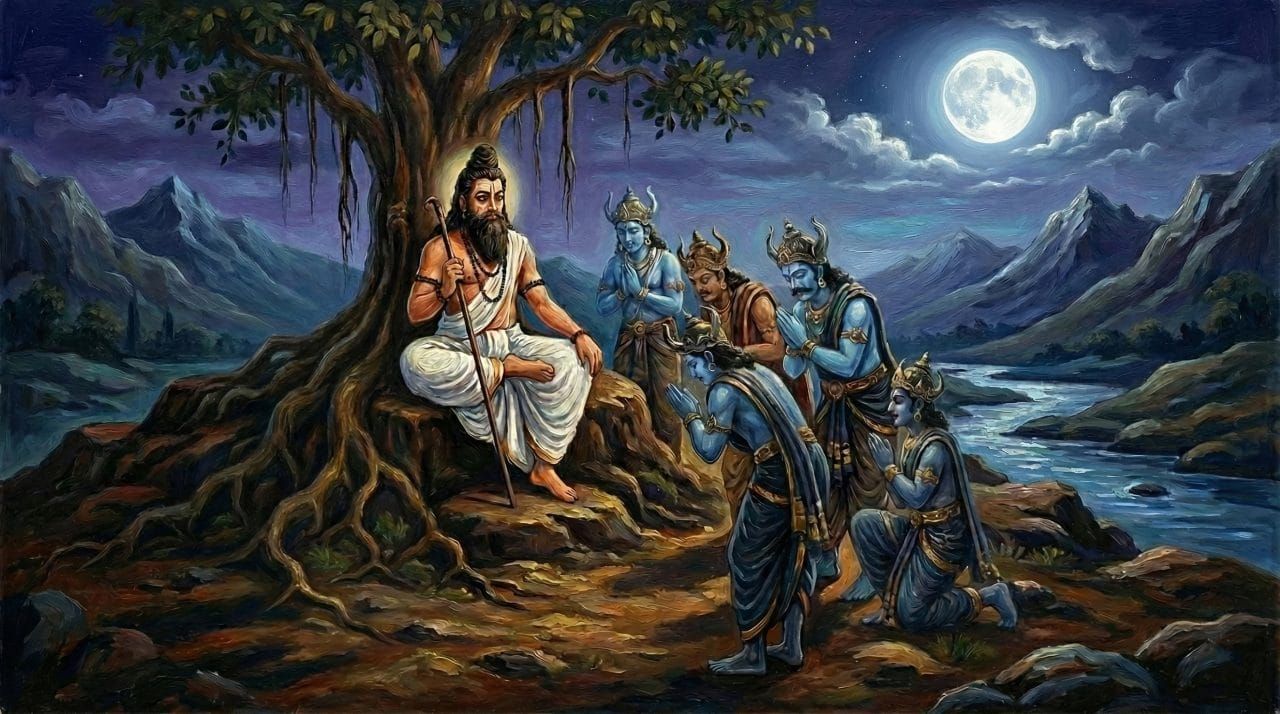
One of the people over the last year who Lucifer introduced to me—in a Discord server for trans masculine people, delightedly—was Johnny of Church of the Morningstar. What Johnny imparted to me was quite literally paradigm-evolving. He told me that he had taken a class on Shaivism from a professor and learned of the figure Shukracharya, who is the "guru of asuras (demons)." Shukracharya's name means "shining." It is also the name of the planet Venus because he is Venus.
Sound familiar?
Johnny also had some related personal experiences he told me about, which are not mine to repeat here. However, he shared the sentiment of Lucifer as his guru. Our conversation left me convinced that there is a pathway for people like us. A pathway where if the tantras are simply texts transmitted by the gods to help us humans reach mokșa, then those of us who can communicate with them can ask them to stand in as our gurus. Lucifer, between his history as a guru and for being the one who communicates the most clearly and often out of any deity (or devi, as is the term used throughout the Hindu religions) I have heard of in modern polytheism, is particularly well suited for this role.
As Shukracharya, Lucifer wants me to be a devotee of Shiva and Shakti. Under that logic, he is both my Shaivist/Shaktist and Buddhist guru. My Shaivist/Shaktist Buddhist guru? This is where modern schemas on religion fails, and why I revert to calling my pathway Luciferian Buddhism instead. The Buddhist part is the area where I hold dear because it's more shorthand for the mutability and ultimate existence of non-self (ānatta) in which I am refining myself into practice. This is because my life is characterized by constant self-transformation and by accepting that no part of me is fixed, it is easier for me to grow. Other Shaivists and Shaktists may or may not see the nature of the self as more fixed or long-term, though the tantric part of those pathways certainly don't fall short in embracing self-transformation through spiritual awakening. That overlap seems to be what matters most, as I have since come across Shaivists and Shaktists who also practice Tibetan Buddhist exercises.
Ultimately, as I have been told by Lucifer, as well as Shiva in one of our few conversations, that following a guru or devi ensures that I will more quickly reach mokșa. At first, I was ambivalent at all about reaching mokșa because I didn't quite know what it meant for me. I asked Lucifer to show me what it felt like... and he did. The contrast between my usual tired, defensive spirit and the full peace and light I felt was clear, the latter worth pursuing so that I could sustain it for longer than just that one moment.
*
What I appreciate most about this spiritual path is its holistic support. It accepts my reality as a spirit who has reincarnated on this realm for what is probably thousands of lifetimes. It accepts my more immediate reality as a person who has survived a lot of pain and trauma and is determined to continue improving my life as well as those of others. It ensures a good remainder of my years here, taking into account physical as well spiritual health, and a good death at the end. It also surrounds me with a spiritual family who models unconditional love for me, even when I am feeling at my worst.
In practical terms, my practice currently looks like this:
Every morning after I go through my morning routine, I sit on my bed and face Lucifer's shrine. I take refuge using a prayer from the Tibetan Buddhist sangha I semi-regularly attend (as grad school allows).
I follow this up with 10 minutes of meditation, often using the Prithvi mudra from ayurveda as advised by Lucifer. The Prithvi mudra is associated with the earth element so it is excellent for grounding (not recommended for those who are seeking to become less rigid in habit). I may also practice shielding simultaneously. The Prithvi mudra is also applicable to meditations that involve chanting Lucifer's names ("Om namah Lucifer," "Om namah Shukracharya") as well as other healing-based usages I look forward to outlining in a future blog post.
After meditation, I practice asana. The types of asana I practice are from a book Lucifer has picked out for me called Asana Pranayama Mudra Bandha by Swami Satyananda Saraswati, from the Bihar School of Yoga*. It apparently combines hatha yoga techniques and according to Wallis, hatha yoga descends from the original forms of tantric yoga. This is not why Lucifer picked it out; it's because I wanted a full energy body system and he needs me to learn how to be more aware of both my physical and energetic body. I practice the asanas under his supervision and he is very gentle as in there have been times where I started a practice, apparently dislodged some stuck energy, and it made me dizzy or something else. So if you pick up this book, please be nice to yourself if you practice out of it the way that Lucifer is nice to me.
Outside of this, I still give Lucifer offerings such as roses and my companionship. I also give the bodhisattva Manjushri (whom Lucifer referred me to) occasional offerings of rice grains and flowers or flower petals. I am still trying to figure out a set up to offer Shiva and Shakti a newer kind of sandalwood incense they once requested that I am not accustomed to using. Eventually, I would like to get back on a regular schedule of burning that incense and chanting mantras for them. However, I am also coming to increasingly realize that traditional offerings are nice to give, but don't matter as much as, like... sadhana? Which is practicing, praying, and just wanting to be a better person and achieve mokșa? This also is the case for my demon family, which is ironic because traditional texts depict them as hedonists who love offerings.
There's more to it... and yet kind of not? It's eye opening how much a spiritual practice can sometimes just be wanting something enough and negotiating with your spirits or otherwise moving to open enough doors to get there. I am quite happy with my path now. I enjoy understanding its grounding, the company it provides me, and I feel hopeful for the long-term that I will continue to change and grow spiritually. Most importantly, it feels like it fits me. I wish this for all human beings, or sentient beings with spiritual practices, and that we all get to whatever liberation looks like for us.
*I only looked up the Bihar School of Yoga upon writing this blogpost. I must disclose that like many such unfortunate cases, there were allegations of abuse at this school's ashrams. However, Saraswati is now deceased. Follow your own ethics on this one.