Integrating Demonology with Buddhist Hell

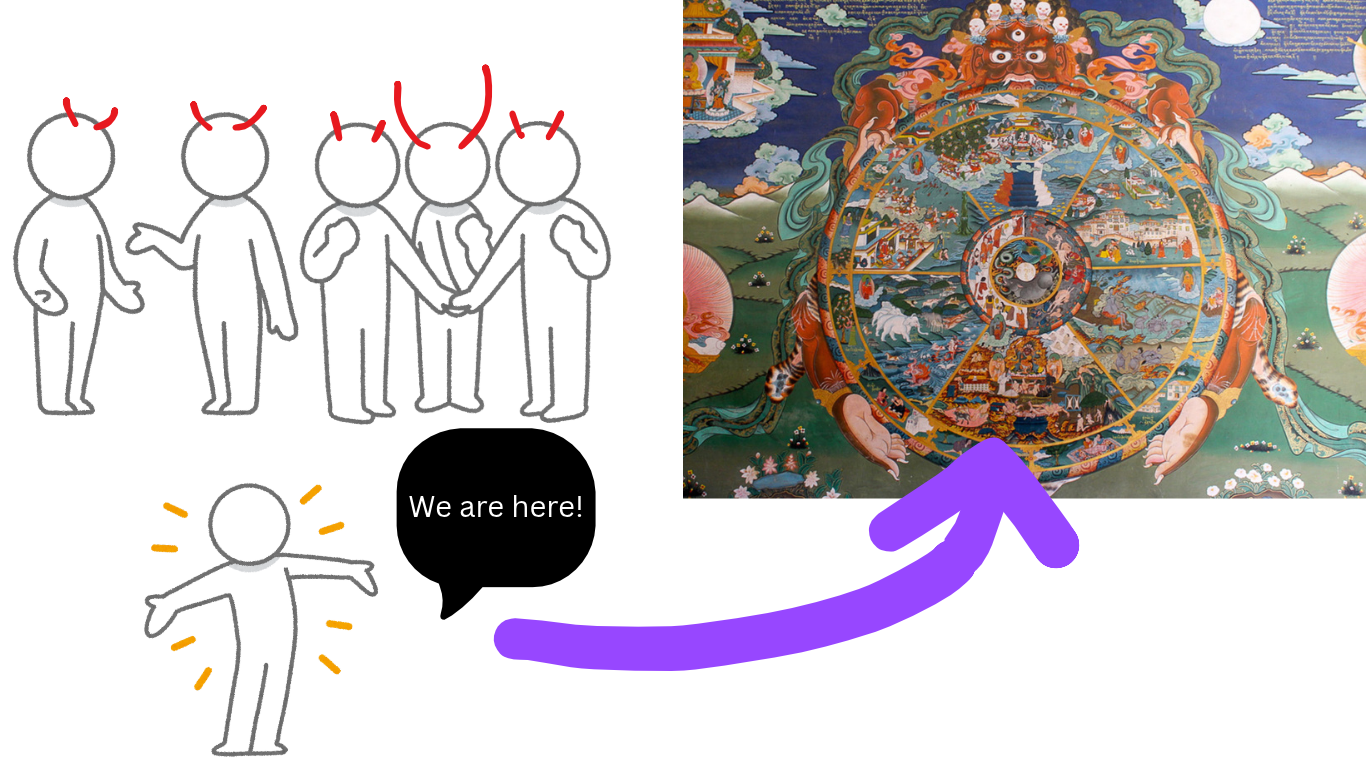
Summary: I share what I learned from a retreat with Jaya Kula about Tibetan Buddhism cosmology, particularly its Hell Realm. I apply this teaching to my observations of demonized spirits' behavior with their devotees.
A Tumblr post reminded me the other day, written from a presumably secular person, was that "30% of the [US] population" believes that the Devil is real and that he is a policy issue, much like the climate crisis is for more rational people. I don't think those numbers were exact, nor meant to be. However, it was an enlightening way to phrase the motivations of a certain class of people in this country, and the shape of their sordid violence against others for simply not wanting to live the types of lives that they desire for themselves. To that class, they are fighting against the evils of the Devil, who is forever aiming to take over the singular earthly realm or draw people into Hell.
I spent this past weekend+ on a four-day retreat hosted by Jaya Kula. The retreat mostly focused on Trika Shaivism Foundations, but the spiritual director Shambhavi also integrates concepts from Dzögchen, a Tibetan Buddhist path. Thus, the final day of our time together was spent with her teaching the Six Realms of Samsara, one of which is called the Hell Realm in English. I had been briefly informed about the Six Realms in casual conversation in the past and I had been curious about this realm for some time. Due to massive cultural differences between basically anytime in Tibetan history and post-Dante's Inferno European Christianity, one can reasonably assume that there is a gulf of understanding of the nature of reality, thus making 'Hell' a translation shorthand for Western comprehension. I wondered how this realm, called naraka in Tibetan, compared to Christian conception.
The way Shambhavi taught our retreat was that all six realms are temporary states of experience, outside of human essential nature. They are characterized by different and difficult emotions, as well as beliefs that stem from those emotions. The Hell Realm is rooted in the belief that life is inherently torturous. It contains the deepest feelings of separation from other living beings that humans can feel. I kept thinking of it as the "mass shooter" realm as Shambhavi described that the other feelings that spawn from this experiential realm include rage, opposition, persecution complexes, vengefulness, hopelessness, and despair. It is the place where homicidal urges live as well as the place of suicidal tendencies (but again, it is a place all of us travel through at some point).
There was no indication in what I was taught that there are particular spirits overseeing the Hell Realm in Tibetan Buddhism. But I couldn't help but notice through Shambhavi's teaching that many of those feelings heavily color the reality of a lot of people I have observed who have longstanding relationships with Lucifer and spirits who fall under the Goetia. The type of mental and spiritual illnesses these people struggle with are often accompanied by deep feelings of separation from others because, indeed, their reality does not match the consensus of those around them. There is also the stigma of complex mental health issues, keeping them in an outsider status and thus keeping them lonely.
These are the types of people that demonized spirits are known to sit with in their darkest moments when other spirits only offer other types of help. Some of them are not so much followers of these spirits inasmuch as they are adoptees, myself included. This makes me think that demonized spirits do, indeed, preside over Hell, but not in the way as articulated by Tucker Carlson and his ilk. Instead of maintaining Hell by keeping humans lonely, the spirits teach their adoptees to cope with their feelings or make life adjustments in order to become more adaptable to reality's everchanging circumstances. The material gifts extolled within the grimoires sort of also align with this, even as they were originally intended to be excuses for Christian users to seek out demons. For instance, I have covered before that one of Belial's skills is to "bring good familiars." Gifting a human a compatible companion animal wouldn't be exactly an effective way to keep them miserable, after all.
Jaya Kula's lineage of Trika Shaivism believes that Shiva and Shakti are the artists of reality, and that the limitations they put upon it are to create diversity. Thus, as Shambhavi says, nothing that is in this world is inherently evil. So I think it's fair to still say that Lucifer and his pantheon are of Hell, but with the reasoning that they preside over the more difficult emotional experiences that constitute Hell so that humans can overcome this state and travel on "the path" to return to unification with wisdom.
As for Lucifer himself, there was a significant time soon after we joined in our own union that he took me to see Shiva and Shakti. His interactions with them were admiring and adoring, not dissimilarly to how I have seen Shambhavi's students look at her. Both Shaivism and Tibetan Buddhism teach that there are two types of devas; the creative and/or fully Enlightened figures like Shiva/Mahadev, and "minor deities" who are still on the path like us. Between not trusting the limits of my own perceptions, and still having Abrahamic notions of perfect deity that I had not yet deprogrammed, it has taken me a long time even with seeing this to accept that this is Lucifer's nature. Hearing about this part of Shaivist/Tibetan Buddhist cosmology at the retreat, knowing that there is an older framework matching what I have experienced with him, provided, well... a freedom to finally believe myself. And to believe Lucifer.
There is no evil. Hell is temporary. There is only all of us, helping each other toward liberation.