Aiming for a Life Without Internet

I feel like the internet was designed to make me feel bad.
This was not always the case. It's been observed that it's likely that my generation would be the last to live in, and therefore remember, an analog world. That means I witnessed the beginnings of the digital world, which once held so much promise. My earliest recollection of the internet was my youthful understanding of it being equivalent to the browser Internet Explorer (b. 1995 d. 2021), which at first showed more error pages than ever actually brought my family members anywhere. Later, I spent so many hours as a teenager hunched over my computer— talking on message boards, reading slash bandfiction on LiveJournal, and using browser tools to discover random places—that I still have bad posture to this day. There was a time, I'm saying, that the internet was actually informative, creative, and connective. I did not feel heavy and poorly while using it.
When a high school friend, whose death I learned of through Facebook years later, told me that Steve Jobs wanted to make the iPhone, I was not able to conceive of what it meant. Apps as well when those came about shortly thereafter. I could potentially catalogue the underestimation of many hours of sleep lost to my smartphones. I could mention the injuries they have inflicted on me, including "text neck" so severe I at one point couldn't lift my arms above my head without pain. Maybe I could mention the friendship blow ups that happened almost all on social media. I could also devote some time writing about how things on the internet itself changed, how corporations took over and shrunk the capacity to host and sustain individual websites, how social media dominates the landscape.
But I won't. You already know. You already know access to email has destroyed any boundaries that supported work/life balance. You already know that the sites are measuring how much people like you against how much other people are liked, according to engagement numbers. You know you are being dopamine-exploited by video algorithms primed to radicalize viewers. You can sometimes still meet people, learn new things, create some stuff, but for the most part you probably spend a lot of time here either because you have to or because the grooves of years-long habits are set deep within you. You have your own stories about how the internet has harmed you, yet you are still here.
Is it worth it?
We all have our own individual thresholds for how long can we be worn down, and know we are being worn down, until we want to make a change. It takes a little while after that to feel like we can make that change, sometimes nebulously, sometimes having to figure out what that looks like*. A lot of us don't believe we can have lives anymore without the internet ("Is that even possible?" one of my work supervisors asked me when I floated the idea). We have somehow, bizarrely, come to accept that we have to partially live in a realm we know does not even work for us anymore and has not for a long time.
I hit my own threshold when I was about a couple of weeks into my internship. I'm a future healthcare provider and life is notoriously exhausting for healthcare providers. I would come home and, like many in healthcare, not be able to do anything other than scroll on my phone. As a result, I would go back to work the next day completely unrestored. I'd come home and repeat, discovering with horror that I physically could not tear myself away from the screen. This would happen even as Reddit, one of my doomscroll sites of choice, had an algorithm that kept showing me things sourced in my deepest triggers. I was in active psychological torment yet I kept scrolling. I had known for years I was not fully in control of how much time I spent on my phone, especially as a person with ADHD. But I had never truly understood until now how much control I'd lost. I was truly in addiction territory.
One of the primary goals of the Trika Shaivist lineage of Jaya Kula, the organization that hosted the retreat I recently attended, is to be immersed in presence. Not to indulge in bad habits sourced in the past or desperately future-plan in hopes of controlling what is to come. To just learn to be. Because to do so is to experience life more and to experience life as fully as one possibly can without fetters is liberation. You can't experience life fully if you are always folded up into your phone. You can't experience life fully if you never try to be in it.
To follow up on my supervisor's question, the truth is I am not going to be able to entirely free myself of internet use. Modern infrastructure is now reliant on smartphones. Even our public transit system in our city doesn't take anything outside of cash (exact or you lose your change) or a digital card. But I am not looking for perfection, as Shambhavi of Jaya Kula taught myself and the other retreat goers about trying to reach jivanmukti, which is the Hindu concept of being a liberated person. We are not ever going to fully get there in our lifetimes, according to the lineage. It's just important to aim to do as much as we can.
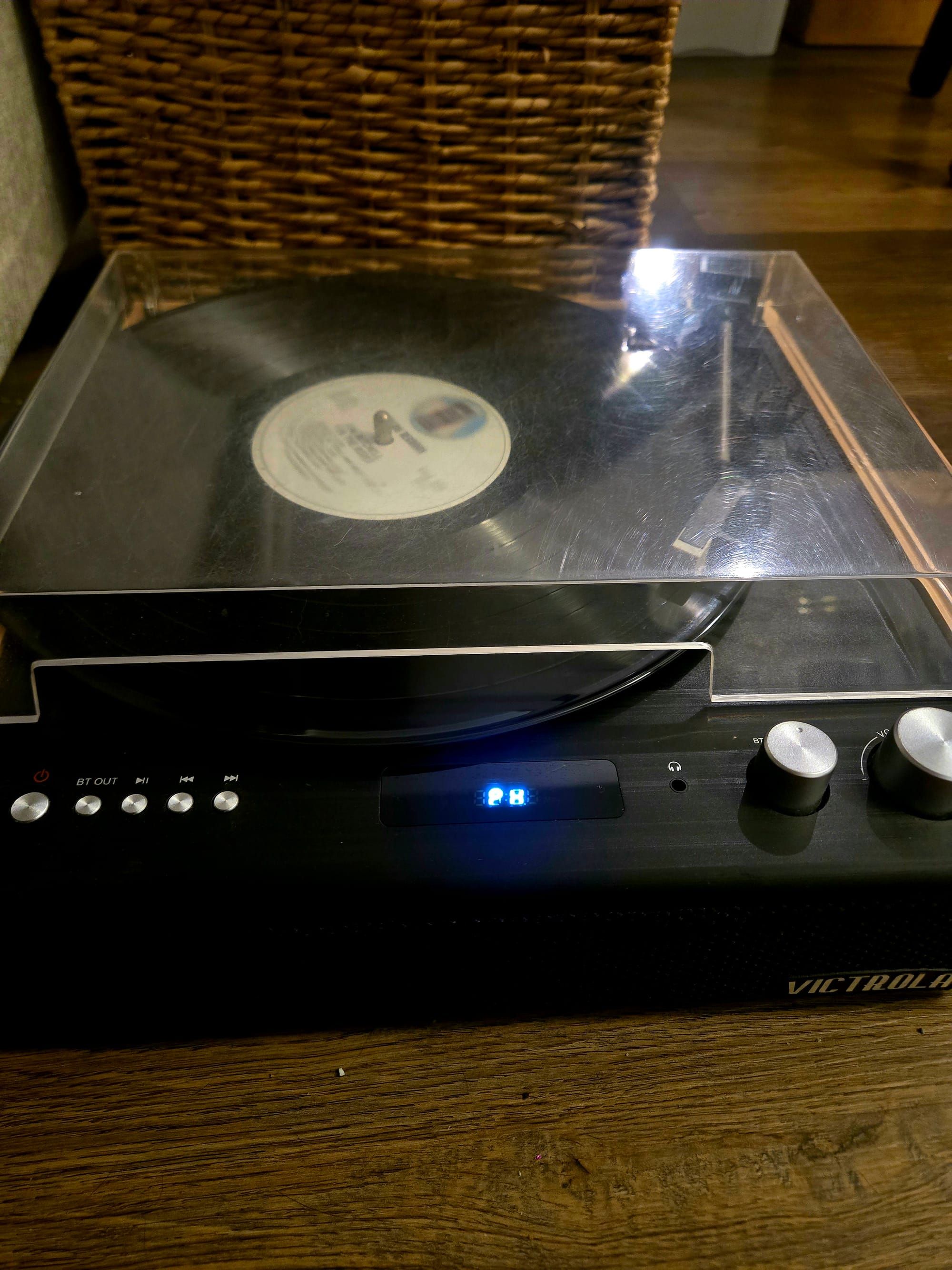
I had already deleted all of my social media, excepting Tumblr, over a year ago in response to the Meta monopoly's anti-transgender policies. More recently, I quit the larger and more active Discord servers that I know hook my ADHD. I started turning off my phone entirely at 9PM so I could learn to relax because even doing nothing is now proven to be cognitively healthier than staring at screens. Today, I bought my first ever record player so I can keep listening to music at night. It's wonderful to have something like my childhood again. An expansive and quiet space where something imaginative can percolate, if it wants to take the time. Physical media that doesn't demand more of my attention than I want to give. I am once again living in a world that feels real.
I'll still be here on this blog. But when I am, it will be with more intention and mindfulness. I will be here because I am using my phone as a utility, not a drug. I will be here in a way where I am able to leave here. I'm writing this because I want you to know that you can too.
*This is according to the therapeutic modality Motivational Interviewing's Six Stages of Change. Contemplation is when a person acknowledges there are concerns with a behavior or habit they have. Afterward, come the separate stages of planning to make a change and acting to make a change.