I'm No Longer Calling Myself an Occultist

As a trans person and a Jew, I recognize that identifiers can be really important. They are terms of which we use to describe ourselves or others in order to better communicate what we value. But sometimes, we pick a label for ourselves based on something once felt in alignment and later on we go through changes, which Buddhism anticipates with the concept of anattā, or "non self."
I'd called myself an occultist the past few years of my spiritual path not insignificantly because of its supposedly masculine associations (woo gender affirmation). Occultism also frequently presents itself as involving a better understanding of the historical context of magical practice versus witchcraft, which seemed to favor a purely experiential pathway. However, in the last few years what I have found instead is that the information shared in occult books and spaces is often fairly limited and specifically European with unexamined colonialist beliefs about spirits and spirit ecology. This leads to a group of people, who are mainly white cis men, intellectualizing about the categories, natures, and functions of spirits all while keeping the actual spirits at an impersonal distance. Many of these people also deny other people's—often Black or brown, queer, or feminine—much more personal relationships, which is quite myopic considering some of the world's major religions (Hinduism, for instance) agree with the personal approach.
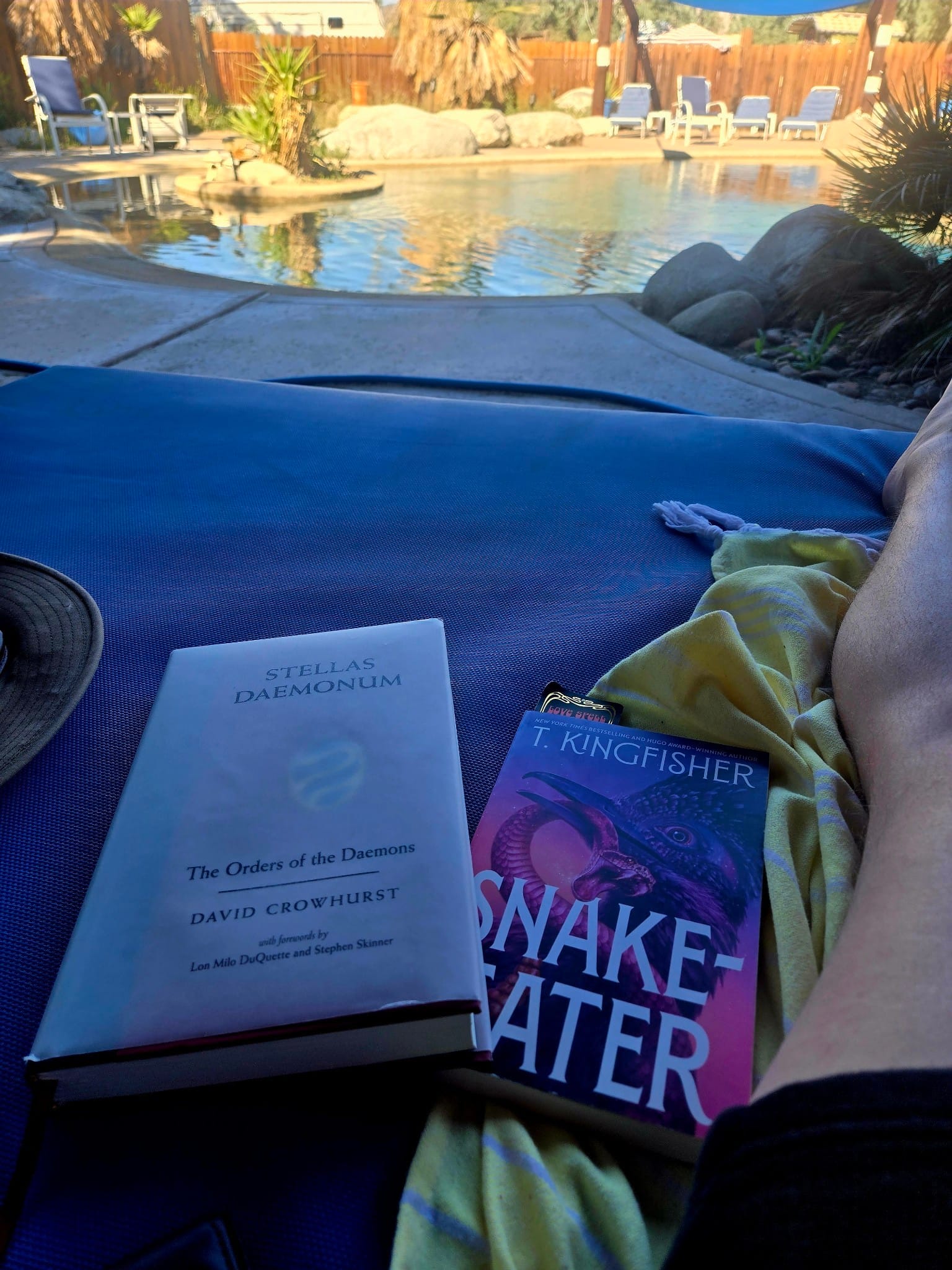
This isn't to say that I think all people on occult pathways are completely diverged from me in terms of spiritual values. Ironically, this realization occurred as I was reading Stellas Daemonum: The Order of the Daemons by David Crowhurst. Near the beginning of this text, Crowhurst advocates for humane ways to treat the entities featured in Goetic texts and in particular recommends the respectful Arabic ways of approaching them versus the crueler European (ala Lesser Key of Solomon) techniques. So on that, Crowhurst and I—as well as more people I have met online who work with infernal entities than not—agree.
I struggled with Crowhurst's book for other reasons. Part of it is because although he clearly researched a lot, he did not track the dates and evolution of academic thought he is clearly referring to. He repeats multiple times, for instance, an understanding of Ba'al and Ashtoreth as being plural localized spirits from the Near East, when actual academics changed their perspective 25+ years ago. This reveals the unfortunate fact that the majority of people who practice the occult, including yours truly, are not experts, just hobbyists. Therefore, even with the abundance of information we have now, some of what is widely disseminated is not up-to-date nor accurate, never mind applicable to creating a strong spiritual practice.
What does help in creating a strong spiritual practice, and what I found lacking in Crowhurst's book, is having an understanding of goals for it. Sometimes, this can be nebulous and we all are entitled to the free space of exploration just for the benefit of it. Gods know I spent literal years just fucking around and finding out and that led me to so much personal development. But, for instance, I had a traumatic experience a few months ago with another occultist who allowed Nazi paraphernalia into the online demonalatry space he helped run. This person, in the past, went on and on about about seeing Astaroth's "emanations" as if it was the ideal of spiritual practice. Meanwhile, Astaroth recently nudged me to go to a mutual aid fair where I finally got Narcan trained, which I hopefully will never have to use, but if I must I can now save somebody's life.
In the age of rising conservatism and fascism across the globe, it comes into higher question of why occultists focus so much on intellectualizing when relational techniques lead to more concrete positive effects. But a lot of occultists who hold identities of power and privilege are very resolutely not asking themselves this question. I can only presume that they do not believe their spiritual path is meant to help them self-improve as well as aid other living beings.
If that's truly the case, I can learn very little if anything at all from such people. Therefore, I have to revisit how I create and sustain a spiritual practice around the "Goetia," or "demons" as many people call them without realizing they're using a very overgeneralizing and unnecessarily stigmatizing term, or the "infernals" which I've seen some people call them and I like better, or simply "Lucifer's pantheon" because one of the few consistent things about these beings is that he rules them. Lucifer clearly intends for me to not have to do this work on my own by sending me fellow Luciferian witches whenever possible, which is a relief. But also I can already see how I am going to be challenged to deconstruct my ideas about what I think I want a spiritual practice to look like and oooh, that has the feeling of weightlifting.
I'll take it day by day, I suppose. At the very least, I am now giving up the concept of becoming a roleplay expert of the infernals via reading goetic texts and understand more deeply why I've been more often pulled to my studying of Buddhism. I need a spiritual practice that is not only very happy that I am doing the day-by-day thing, but also supports my goals of improving myself as a person and contributing to my communities. In a time of fascism—and with commitment to the Buddhist path I hope to take—I resist labels with the intent of emphasizing my actions, which I aim to be compassionate toward all spirits.